
Over recent weeks, I have been exploring the role of storytelling in the work of community organisers. In November and December, I looked at the way stories structure our world, giving us identity with others and shaping our perceptions. We discussed how stories have provided the basis of civilisations and dynasties, offered entertainment for millions and given us some of the most recognisable figures in our lives. Since December, I have introduced the ideas of Marshall Ganz who argues that community leaders need to develop and perfect a Story of Self, a Story of Us and a Story of Now. In my last two posts, I looked at the way powerful narratives play out in the life of our communities and the way we need to ensure our stories privilege the marginalised and dispossessed.
 In this last of the series, I seek to give you a set of practical guides to developing your skills as a storyteller. Many would suggest that human beings are by nature storytellers, taking every opportunity to structure their environment with meaning and to develop elaborate sagas of their own and their people’s journey. We dream in stories, our science tells us stories of origins and processes, children play in stories, businesses are encouraged to express their mission as a story, we seek entertainment, even horror in stories. In fact you are an experienced storyteller by the time you are six. You can of course become a better, more conscious quilter of narrative and use the art in your work for the community.
Capturing your Community’s Saga
Your people already have already told the story of their community; the problem is that it is scattered across many households and age groups. Getting people to tell their part of the community story – and recognising it as such – is a fantastic way to bridge people’s understanding of the shared journey so far. When different accounts of the same event are shared, it can split or reinforce a sense of common purpose. The community leader has the role of helping the group recognise each other in the narratives and to bring the accounts together to build on each other.
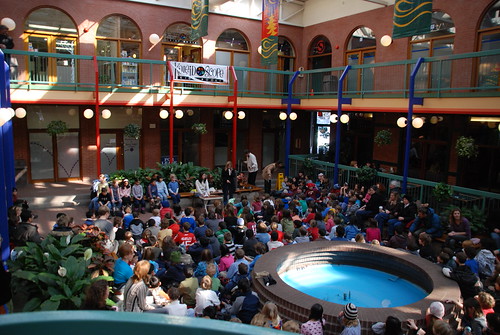
 Holding a story-telling party is one way to get the community’s saga told. Gathering the best storytellers together, you can give them ten minutes each to tell the group about an incident in the community’s life. Then other people are given five minutes to add, challenge or change the story in accord with their memory. In an evening, you might get five or six stories and if you plan it right, you could cover the major community crises and successes for the last few decades. Recording the conversation can give the community a place to start from in constructing it’s own shared biography.
Building your Style
Personal stories make riveting listening. If you have not yet got to grips with your own Story of Self, then may I encourage you to revisit my post here and have a go at your own story. As you learn to tell your stories – of Self, of Us and of Now – more effectively, you will begin to recognise that they work best if you follow some tried and tested guidelines. A good story follows these guidelines:
- a single theme, clearly defined
- a well-developed plot with a great opening, pace and intrigue
- uses vivid word pictures and pleasing sounds and rhythm
- characters are well drawn, handling antagonist / protagonists well
- metaphor and analogy give it depth
- remains faithful to the source
- there is a strong drama involved with a powerful lesson to be learnt
- engages the listeners appropriately
 Clearly no one has this off by heart from the outset and retelling your stories in many contexts will give you confidence to devise a style that reflects your own values, approach and personality. In time, your way of storytelling will become inseparable from you and your style will become second nature. New stories, as they arise, will take their place alongside your established portfolio and give you opportunity to tell them still more inspiringly next time.
Using Different Media and Approaches
So far, I have given the impression that stories are verbal and told live in person. Of course, most of the stories we consume are told by other means. And your story telling can take any number of forms – leaflets, newsletters, video, photos, cartoon, novel, audio, street theatre, interview, blogs, social media – and can be delivered in all sorts of creative formats. Each media has its own strengths and weaknesses for storytelling and you should think through what elements your story has, your audience’s situation and how you can best engage them. Written media can be hard for those who struggle with words and visual media can feel ephemeral and insubstantial. Use the right media for your story.
 We have also encountered narratives that are much larger than the individual story, creating for our whole society deep wells of meaning and influencing action and reaction from school children to politicians. These meta-narratives offer ways of tackling uncomfortable aspects of our collective lives such as single parents, migrants, people of different abilities, faiths and cultures, celebrities, oligarchs and princes. The mainstream media often portray these narratives as common sense and ensure they remain in place to support the powerful interests that fund them. As organisers, we need to take a critical look at such stories and work in our local setting to undermine the demeaning of our fellow citizens with stories that build solidarity, compassion and empathy. The future of our communities lies with the story-tellers!
Resources
Center for Story-based Strategy (2013) Workers Rising Up www.storybasedstrategy.org/blog/workers-rising – an example of storytelling of a campaign to demand dignity for US workers at Walmart and McDonalds
Aunt Renie (2013) The Future of Storytelling – a course from Iversity at http://www.youtube.com/user/officialStoryMOOC . See also https://iversity.org/courses/the-future-of-storytelling
Barry McWilliams (1998) Effective Storytelling – a manual for beginners Available at http://eldrbarry.net/roos/eest.htm
Chicago Public Media (ongoing) This American Life – a weekly storytelling podcast – wildly successful on iTunes
The Moth (ongoing) The Moth Podcast – another weekly storytelling podcast – live unscripted true stories delivered to packed audiences – also found free on iTunes
Benedict Carey (2007) This is Your Life (and How You Tell It) in Mental Health and Behavior in The New York Times Fascinating insight into the psychological role of storytelling for the individual. Available at here
 Make it Human
 So as organisers we need to look for stories in our work that allow individuals and families to speak for the issue. People get the pain and trauma of others; they recognise in other’s circumstances, their own dilemmas and they celebrate as with family members when others overcome the odds stacked against them. Making people just like us heroes of our stories gives our community members the opportunity to see themselves as potential heroes and heroines. And what is true for one or a small group can be seen to be available for many in the crowd.
 Frames are also bound to the culture of your audience. If your community gives precedence to older people, then your narrative of change needs to take that into account. You may of course want to offer an alternative perspective – that young people have an energy and drive to offer, for example – but you need to take the existing frame into account in developing your narrative. Change driven through by energetic young people may just fall on deaf ears if you are not also able to justify how the wisdom and experience of older people also contributed. This cultural awareness is difficult to achieve as we are often shielded from the general view by our own bias toward alternative perspectives and values that sit ill with the prevailing mood. Testing your stories with different audiences is the only way to be sure of what works.
 Organising is about building community members’ sense of their shared destiny and their capacity to take collective control of their lives. Narratives are the way we touch the emotions of our supporters and our opponents; they transcend the immediate concerns of the moment and offer a relationship with the larger dimensions of life and death, over time and space. Solidarity is built from a sense of common humanity and shared purpose and we gain awareness of the human struggle of others through stories of dilemmas overcome, wrongs righted and dragons slain.
 Any reader who has browsed this site or read more than a few of my posts will know that I am absorbed by power and its influence on our society. Today I want to consider how stories are used to powerful ends. My thinking on this has been essentially formed by Winning the Story Wars by Jonah Sachs who lays out in strong prose the development of marketing and public affairs. He argues convincingly that we are in an age when the story is king. Policy making, economic development and social relations are fundamentally structured by the stories we believe. I will illustrate this with three current examples and then next time draw out the implications for organisers.
 Strivers and Skivers
 Austerity and Neoliberalism


 No story is complete without an audience. Your Story of Now – like your Story of Self and your Story of Us – needs to resonate with your listeners. In your choice of images, the characters in your stories, your language and metaphors, you need to judge carefully how they will be heard by your intended recipients. A great story can lose credibility if it does not relate to the experience of your audience. Give them your very best links so they can see how what you are telling them has immediacy for their situation, how it motivates them specifically for this action now.

 The Story of Us
 Organisers and Us
 Origins and Identity
 The Story of Us is an evolving entity. It is never finished and when we sit down to reflect, we are able to update and revise it to match our current situation. As I have said before, story is all around us and a strong, clear and inspiring Story of Us is a critical part of shifting the power toward a community. Who are we? What do we stand for? Where have we come from and what resources do we have to make our future from? Building a collective narrative provides a bedrock to sustain hope in the face of adversity and identity in face of challenge.
 Leadership in communities is often about achieving with others in the face of uncertainty. Often the way you present your work – and the work to which others are called – can make or break the commitment of your leadership group. Your narratives are a key way in which you influence the life of the community, bringing a sense of can-do to an apparently hopeless situation, giving people confidence to voice disagreement or opening up new possibilities by sharing experience from elsewhere. We are only able to translate the values we hold into action through inspiring stories. We tap into the inherent feelings of the community and give that form through the right story, the right framing or the right meme.
 Such acts of leadership can of course come from any member of the community and not just from the organiser. However, the art of public narrative has become a central part of the community organising tradition. It takes a particular form that has been most tellingly articulated by Marshall Ganz, a lecturer at Harvard who was part of the great movement to organise the fields and villages of California to deliver rights to those marginal and migrant communities of grape harvesters. His journey from a practical, hands-on organiser to a practical, hands-on academic is recounted in his book Why David Sometimes Wins (details below).


 For community organisers, our own person is the key to communicate our values and vision. Someone working in community without a spark of innovation or a amazing sense of humour or a deep commitment or any number of key elements has little hope of inspiring action in others. Our way of being in that community offers other people a chance to recognise in themselves hidden potential. To make that really work, we need to explore our own life history and develop its possibility to inspire, convince and motivate. In a sense, it’s offering ourselves as an experiment in just what we want other members of the community to be able to do in time: to tell their story authentically, with passion and impact and to make it clear what they stand for.
 The best place to start from is those moments of choice that have deeply affected you. Some may be obvious turning points but others may need seeking out. Choice points have three elements: the challenge you faced, the choice you made and the outcome you entered into. Such narratives – stripped down to these bare elements – will show you operating effectively in circumstances of uncertainty, the actions of a leader. Told humbly with conviction and humour, they will define for others the way you lead. Some might be dramatic confrontations, others incidents that taught a valuable lesson. Your stories – four or five at first but more as you grow used to developing them – become your calling card and your lasting legacy.
 Finding the stories is key but you must also use them again and again in practice so you develop an authentic way of telling them that evokes a response from your listeners. Sharing something meaningful of yourself in this way encourages others to do the same – tell their story and own their ability to bring about change. By telling your story you are offering to listen to other’s stories, by opening up your heart to them through your life history you give community members real insight into the sort of person you have become and how you got here. Practice using the stories with different sorts of people, in different contexts and at a variety of times. These stories – precious to you – will emerge from the repeated telling stronger and more vital if you attend to the response they evoke in others. As you grow better able to tell your Story of Self, try to think how you might

 Two weeks ago, I explored the way in which the way we frame our stories – what we focus on, what’s included and what’s cut out – changes their value base, making them more or less useful in supporting progressive community change. And last week we looked at the structure of myth, how it becomes important in community organising and how you need to ‘construct’ your personal myth to sustain yourself in the role. This week I want to explore the meaning of ‘memes’ for organisers – both as a tool to analyse the power around you and a route to creating your own memes.

 In similar ways, we live with many controlling myths that show themselves in our experience of public life (think the centrality of elections as a way to representation), of our life as a consumer (for example, shopping as a leisure activity) and our perception of our nation (for example, the British always supporting the underdog). I am observing here the nature of the controlling myths that have developed around us, not questioning – or confirming – their truth. Memes often carry whole narratives behind them that in turn are related to certain emotions or responses. For example, John Major in 1993 evoked an idyllic village scene by using a sequence of memes saying, “fifty years on from now, Britain will still be the country of long shadows on cricket grounds, warm beer, invincible green suburbs…” By painting a picture these memes, he drew his audience into a particular emotional place.
 For an organizer, an awareness of such controlling myths allows us to be wary of them. We are often called on to help the community’s leaders to frame their concerns, to draw a clear distinction between their position and that of their opponents and to promote their case in the face of attitudes and values that undermine their position. In these circumstances, helping your people to see the way in which their concerns are shaped, the nature of the memes and narratives used by others and how they can develop their own memes and stories can only make for a stronger appreciation of the way we are manipulated by the powerful. Creating new memes can be a creative route to powerful images and telling analogies capable of changing the way we – and others – see the issues. It’s a key way to open people’s eyes to the complex ways in which we are controlled – and kept powerless!
 I read a couple of weeks ago that folk tales evolve in the same way as species do in biology. That is they follow a pattern of replication with variation that allows social scientists to use the same tools as the biologist to trace the family tree of a particular story to its origins. The example given in the

 Finding ourselves
 Meaning and process

